Biblical Angels Explained: Their Names, Roles, Meanings, and What Scripture Really Says
Biblical Angels Explained: Their Names, Meanings, Roles, and What the Bible Really Says
Angels appear throughout Scripture as messengers, servants, worshippers, protectors, warriors, and agents carrying out the purposes of God. But are all the angel names we hear today actually found in the Bible? This study separates what Scripture clearly teaches from information found in other ancient writings and later religious traditions.
This article focuses first on the Protestant 66-book Bible while also explaining where familiar names such as Raphael, Uriel, Raguel, Sariel, Remiel, and Metatron come from.
The images throughout this study are historical artistic representations. No authentic photograph of Michael, Gabriel, cherubim, seraphim, or another biblical angel exists.
The purpose of studying angels is not to worship them, pray to them, summon them, or become spiritually dependent upon them. Biblical angels point us back to God, whom they worship and serve.
"Are they not all ministering spirits, sent forth to minister for them who shall be heirs of salvation?"
Explore This Bible Study
What Are Angels?
Angels are spiritual beings created by God. They are not gods, they are not equal with God, and they do not possess His authority independently.
Throughout Scripture, angels serve God, deliver messages, praise Him, assist His servants, participate in spiritual conflict, and sometimes carry out divine judgment.
"Bless the LORD, ye his angels, that excel in strength, that do his commandments, hearkening unto the voice of his word."
The Hebrew word often translated as angel is mal'ak. The Greek word is angelos. Both words carry the basic idea of a messenger.
Scripture also describes different types of heavenly beings. Therefore, every heavenly being in Scripture should not automatically be assumed to look or function exactly the same way.
Do People Become Angels When They Die?
The Bible does not teach that human beings become angels after death. Humans and angels are presented as distinct creations.
In Matthew 22:30 Jesus says that people in the resurrection are "as the angels of God in heaven." Being like angels in a particular respect is different from becoming angels.
Michael the Archangel
Name Meaning: Michael is commonly understood to mean "Who is like God?"
Michael is one of the holy angels personally named in the Protestant 66-book Bible. He is also the only individual explicitly called the archangel by name.
"Yet Michael the archangel, when contending with the devil he disputed about the body of Moses..."
Daniel 10:13 describes Michael as "one of the chief princes." Daniel 12:1 calls him "the great prince" connected with God's people.
"And at that time shall Michael stand up, the great prince which standeth for the children of thy people..."
Revelation 12:7 also describes Michael and his angels fighting against the dragon and his angels.

Historical artistic representation. Scripture does not provide an actual photograph or complete physical description of Michael.
Gabriel
Name Meaning: Gabriel is commonly understood to mean "God is my strength," "strength of God," or "mighty one of God."
Gabriel appears in both the Old and New Testaments and is strongly associated with delivering and explaining important messages from God.
"And the angel answering said unto him, I am Gabriel, that stand in the presence of God..."
Gabriel announced the coming birth of John the Baptist to Zacharias.
He was later sent to Mary concerning the miraculous birth of Jesus Christ.
"And in the sixth month the angel Gabriel was sent from God unto a city of Galilee, named Nazareth."
Gabriel also appears in Daniel 8:16 and Daniel 9:21 in connection with the interpretation of revelation.

Historical artistic representation of Gabriel from an Annunciation group. This is artwork, not a photograph or exact biblical depiction.
Michael and Gabriel at a Glance
| Name | Meaning | Biblical Role | Key Scriptures |
|---|---|---|---|
| Michael | Who is like God? | Archangel, chief prince, heavenly conflict | Daniel 10:13; Daniel 12:1; Jude 1:9; Revelation 12:7 |
| Gabriel | God is my strength | Messenger and interpreter of revelation | Daniel 8:16; Daniel 9:21; Luke 1:19; Luke 1:26 |
Cherubim
Cherubim are powerful heavenly beings associated with God's holiness, presence, glory, and throne.
Their first biblical appearance occurs after Adam and Eve are expelled from the Garden of Eden.
"So he drove out the man; and he placed at the east of the garden of Eden Cherubims..."
God also commanded images of cherubim to be placed upon the mercy seat of the ark of the covenant.
Ezekiel gives one of Scripture's most extraordinary descriptions of heavenly beings. His vision includes wings, multiple faces, unusual movement, wheels, and imagery connected with the glory and throne of God.
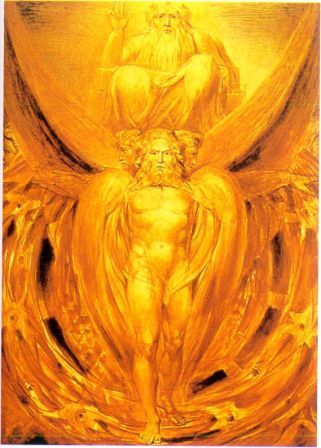
Historical artistic interpretation inspired by Ezekiel. It should not be treated as a photograph or exact reconstruction.
Seraphim
Seraphim appear prominently in Isaiah's vision of the Lord seated upon His throne.
Isaiah describes each seraph as having six wings.
"Above it stood the seraphims: each one had six wings... And one cried unto another, and said, Holy, holy, holy, is the LORD of hosts: the whole earth is full of his glory."
Their activity centers upon God's holiness, worship, and glory.
The Hebrew term translated seraphim is commonly associated with the idea of burning or fiery ones.

Historical Bible illustration inspired by Isaiah 6. Artistic representation only.
The Four Living Creatures
Revelation 4 describes four extraordinary living creatures surrounding God's throne.
"And the four beasts had each of them six wings about him... and they rest not day and night, saying, Holy, holy, holy, Lord God Almighty..."
The KJV uses the word "beasts" in this passage, while many modern English translations use "living creatures."
One is described as resembling a lion, another a calf, another having a face like a man, and another resembling a flying eagle.
Their activity centers around continual worship of God.

Historical stained-glass interpretation inspired by Revelation. This is artwork, not a photograph of heavenly beings.
The Heavenly Host
When Jesus Christ was born, Scripture records a multitude of the heavenly host praising God.
"And suddenly there was with the angel a multitude of the heavenly host praising God, and saying, Glory to God in the highest, and on earth peace, good will toward men."
The expression "heavenly host" can describe the great heavenly multitude or army belonging to God.
Notice where their attention goes. They praise God. Biblical angelic appearances should ultimately direct attention toward God rather than toward the angel.
The Watchers in Daniel
Daniel 4 uses the unusual expression "a watcher and an holy one."
"I saw in the visions of my head upon my bed, and, behold, a watcher and an holy one came down from heaven."
The passage describes a heavenly messenger connected with the announcement of judgment concerning King Nebuchadnezzar.
Ministering Angels
"Are they not all ministering spirits, sent forth to minister for them who shall be heirs of salvation?"
Throughout Scripture angels deliver messages, strengthen God's servants, participate in divine missions, and carry out God's commands.
Their ministry should direct our attention toward God's care, power, and sovereignty rather than making angels themselves the focus of our faith.
Angels and God's Protection
Scripture teaches that God can command angels concerning His people.
"For he shall give his angels charge over thee, to keep thee in all thy ways."
"Take heed that ye despise not one of these little ones; for I say unto you, That in heaven their angels do always behold the face of my Father which is in heaven."
These passages demonstrate that God can use angels in connection with protection and ministry.
Angels of Judgment
Biblical angels are not merely comforting figures. Scripture also records angels carrying out judgments commanded by God.
Second Samuel 24 describes an angel involved in judgment upon Israel.
The book of Revelation also records numerous angels participating in divine judgments.
These passages remind us that biblical angels are servants of a holy God and should not be reduced to decorative characters.
The Seven Angels Before God
"And I saw the seven angels which stood before God; and to them were given seven trumpets."
Revelation clearly describes seven angels standing before God.
However, Revelation does not give us the personal names of all seven angels.
The Angel of the LORD
The Old Testament repeatedly uses the expression "the angel of the LORD."
The Angel of the LORD appears in passages involving Hagar, Abraham, Moses, Gideon, and others.
Some Christian interpreters understand certain appearances as manifestations of Christ before His incarnation.
Other interpreters understand them as appearances of a heavenly messenger representing God with divine authority.
Key Scriptures: Genesis 16:7-13; Genesis 22:11-18; Exodus 3:2-6; Judges 6:11-24.
Fallen Angels
Scripture teaches that some angels sinned and rebelled against God.
"For if God spared not the angels that sinned, but cast them down to hell..."
"And the angels which kept not their first estate, but left their own habitation..."
Revelation also describes the dragon and his angels fighting against Michael and his angels.
Was Satan Originally Named Lucifer?
"How art thou fallen from heaven, O Lucifer, son of the morning!"
The immediate context of Isaiah 14 contains a proverb against the king of Babylon.
The word rendered "Lucifer" in the KJV came through the Latin translation tradition and carries the idea of a shining or morning figure.
Many Christian interpreters throughout history have also understood the passage as symbolically reflecting Satan's pride and fall.
Abaddon or Apollyon
"And they had a king over them, which is the angel of the bottomless pit, whose name in the Hebrew tongue is Abaddon, but in the Greek tongue hath his name Apollyon."
Abaddon and Apollyon are associated with destruction or a destroyer.
Where Did Raphael, Uriel, and Other Angel Names Come From?
This is where much of the confusion surrounding angel names begins.
When discussing holy angels personally named in the Protestant 66-book Bible, the two clear names are Michael and Gabriel.
Raphael
Raphael appears in the Book of Tobit.
Tobit is included in the Catholic biblical canon and in various Orthodox traditions, but it is not included in the Protestant 66-book canon.
Uriel
Uriel appears in ancient religious writings and traditions associated with texts such as 1 Enoch and 2 Esdras.
Uriel is not personally named in the Protestant 66-book Bible.
Raguel
Raguel appears in ancient Jewish traditions, particularly material associated with 1 Enoch.
Raguel is not personally named in the Protestant Bible.
Sariel
Sariel appears in ancient Jewish angelic traditions, including textual traditions associated with 1 Enoch.
Sariel is not personally named in the Protestant Bible.
Remiel
Remiel is another angelic name appearing in ancient Jewish apocalyptic literature.
The name is not found as the personal name of an angel in the Protestant Bible.
Metatron
Metatron comes from later Jewish mystical traditions.
Metatron is not a named angel in the Bible.
Which Angel Names Come From Which Source?
| Name | Source | In Protestant 66-Book Bible? |
|---|---|---|
| Michael | Daniel, Jude, Revelation | Yes |
| Gabriel | Daniel and Luke | Yes |
| Raphael | Book of Tobit | No |
| Uriel | Ancient writings including 1 Enoch and 2 Esdras traditions | No |
| Raguel | 1 Enoch traditions | No |
| Sariel | Ancient Jewish writings | No |
| Remiel | Ancient Jewish writings | No |
| Metatron | Later Jewish mystical tradition | No |
What Do Biblical Angels Actually Look Like?
There is no single physical description that applies to every angel or heavenly being in Scripture.
Some angels appear in human form.
Seraphim are described with six wings.
Cherubim have extraordinary features in Ezekiel.
Revelation describes unusual living creatures surrounding God's throne.
No genuine photograph of Michael, Gabriel, cherubim, seraphim, or another biblical angel exists. Images used in this article are historical artistic interpretations.
Should Christians Pray to Angels?
The Bible does not instruct Christians to pray to angels.
"Then saith he unto me, See thou do it not... worship God."
When John attempted to worship before an angel, the angel redirected him toward God.
Angels may serve God powerfully, but worship belongs to God.
Frequently Asked Questions About Biblical Angels
How many holy angels are personally named in the Protestant Bible?
Michael and Gabriel are the two holy angels personally named in the Protestant 66-book Bible.
Is Michael an archangel?
Yes. Jude 1:9 explicitly calls Michael "the archangel."
Is Gabriel an archangel?
The Bible identifies Gabriel as an angel but never explicitly gives him the title "archangel."
Is Raphael in the Bible?
Raphael appears in Tobit, which is included in Catholic and various Orthodox biblical traditions. Raphael is not named in the Protestant 66-book Bible.
Is Uriel in the Protestant Bible?
No. Uriel appears in ancient religious writings and traditions outside the Protestant 66-book canon.
Do all angels have wings?
No biblical verse states that every angel has wings. Some heavenly beings clearly have wings, while many angel appearances do not mention wings.
Do humans become angels after death?
No. Scripture presents humans and angels as different creations.
Can angels protect people?
Yes. Scripture records God commanding angels concerning protection. The power and authority remain with God.
Does everyone have a guardian angel?
Scripture contains passages concerning angelic protection, but it does not give detailed information about a named personal guardian angel assigned to every individual.
Should Christians try to contact angels?
The Bible gives Christians no instruction to summon angels or seek direct communication with them. Christians are instructed to seek God and remain grounded in His Word.
Are cherubim and seraphim the same thing?
No. Scripture describes cherubim and seraphim differently and places them in different biblical scenes.
Keep Your Focus on the Creator
Angels are fascinating, but studying them should lead us toward greater reverence for God rather than fascination with created spiritual beings.
Faith belongs in God.
Prayer belongs to God.
Worship belongs to God.
"And all the angels stood round about the throne... And worshipped God, Saying, Amen: Blessing, and glory, and wisdom, and thanksgiving, and honour, and power, and might, be unto our God for ever and ever. Amen."
Even the angels worship God. Studying them should ultimately teach us more about the holiness, authority, wisdom, power, and majesty of the God they serve.
Final Biblical Reminder
Whenever you encounter an angel name, spiritual hierarchy, supernatural claim, or mystical teaching online, compare it carefully with Scripture.
"Beloved, believe not every spirit, but try the spirits whether they are of God..."
Ancient writings can be historically interesting, but historical tradition should not automatically be presented as direct biblical doctrine.
Continue Growing in God's Word
Explore more Scripture-based prayers, Bible teachings, Christian articles, and ministry resources at Avery Raquel Ministries.